READ THIS FIRST
AI is not the problem. The sequence is.
I am pro-AI. I am not pro-math that only works in PowerPoint.
The evidence is already clear on both sides. AI can improve performance on well-bounded tasks, but results vary by worker experience and task fit. At the same time, most organizations remain short of enterprise-scale financial impact, and many finance teams still lack a complete view of AI costs.2.02
The failure pattern I am challenging is simple: announce the ambition, buy the tools, calculate headcount savings, and discover the real workflow after the people who understand it have left.
CORE POSITION
A company should not eliminate a specialist until the workflow has been documented, rebuilt, tested, and proven without depending on that specialist to correct it.
THE FIVE POINT VERSION
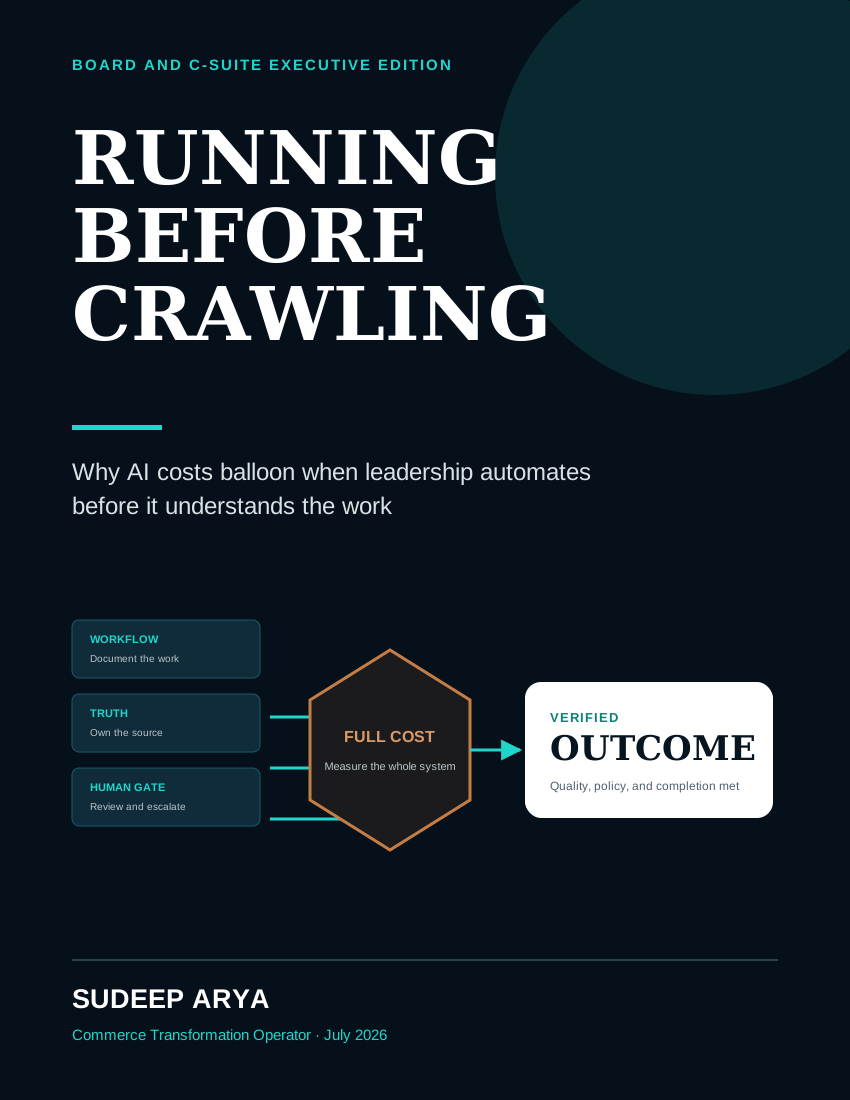
- Measure the full cost per verified outcome, not the price of a seat or a million tokens.
- Rebuild the workflow before automating it.
- Use specialists to teach, test, and govern the system before deciding what capacity can safely change.
- Keep accountability with the company, not the model or vendor.
- Approve workforce savings only after the operating evidence exists.
AUTHORSHIP AND AI DISCLOSURE
This is my work: the thesis, thinking, writing, judgment, original frameworks, creative direction, and management perspective are mine. I used AI as a research and production tool to organize sources, pressure-test claims, refine language, develop visualizations, and strengthen the digital presentation. I directed the work, made the editorial and analytical decisions, reviewed the evidence, and approved the final publication. AI accelerated and strengthened the process; it did not originate, own, or authorize the point of view.
KEEP THIS QUESTION IN MIND
Are we building a capability, or merely moving a cost from payroll into technology?
THE BOARDROOM SHORTCUT
The fastest route to a bad AI business case
The shortest route to a bad AI business case is to begin with the person you want to remove.
- 01AnnounceAI ambition
- 02Countroles to remove
- 03Buytools and vendors
- 04Meetthe exceptions
- 05Repair / Rebuildthe operating model
Learn moreThe survey evidence behind the shortcut
McKinsey's 2025 survey found that 88% of respondents reported regular AI use in at least one business function, yet nearly two-thirds said their organizations had not begun scaling AI across the enterprise. Only 39% reported any enterprise-level EBIT impact. Organizations described as high performers were nearly three times as likely to have fundamentally redesigned workflows and were more likely to define when human validation was required.3.03
The Wall Street Journal reported that only 26% of companies in a KPMG survey had a comprehensive view of AI costs. KPMG also said it was working with companies that had exhausted annual token and cloud-computing budgets in a matter of months.3.04
A demo is a first date. Production is the joint checking account.
The board does not need less ambition. It needs the workflow and the economics before the savings are booked.
ASK IN THE ROOM
What did we measure before we priced the headcount reduction?
THE LINE-OF-SIGHT GAP
Adoption is broad. Economics are not.
The market does not have an adoption problem. It has a line-of-sight problem.
Gartner forecast: More than 40% of agentic-AI projects could be canceled by the end of 2027 because of escalating cost, unclear value, or inadequate risk controls. A forecast, not a measured failure rate.
Learn moreHow to read the adoption and economics data
These numbers do not prove that AI lacks value. They show that usage can become common before workflow redesign, cost visibility, and verified enterprise return become common.4.03
Gartner forecast that more than 40% of agentic-AI projects would be canceled by the end of 2027 because of escalating costs, unclear business value, or inadequate risk controls. That is a forecast, not a measured failure rate. It is still a useful warning about scaling an architecture before proving the work.4.04
A pilot that stops is not a failure. A pilot that cannot stop is.
BOARD CHECK
Which metric proves value rather than adoption?
THREE EXECUTIVE RECEIPTS
The public record is already giving boards clues.
Public candor is more useful than another victory lap. Three executive moments already show what happens when cost, capability, and confidence are allowed to move at different speeds.
Reported annual AI budget exhausted in four months; value link not yet visible.
Company-reported work equivalent of 700 full-time agents; later course correction.
About 7,000 homes representing roughly $2.8B in inventory at shutdown.
Learn moreWhat happened at Uber, Klarna, and Zillow
UBER: The meter moved faster than the value link.5.03
The Verge reported that Uber had exhausted its annual AI budget four months into 2026. President and COO Andrew Macdonald said the connection between rising Claude Code token consumption and useful consumer features was not yet visible, and that token cost would need to be weighed against headcount. His candor is valuable. My question is why that line of sight was not part of the approval logic before the budget was reportedly gone.
KLARNA: The cost objective became the correction.5.04
Klarna company-reported that its assistant performed work equivalent to 700 full-time agents. Reuters later reported that CEO Sebastian Siemiatkowski said the company had over-indexed on AI cost cutting, was course correcting, and had returned to hiring. This is not hypocrisy. It is a public correction from fewer people toward better products and service.
ZILLOW: Forecast confidence reached the balance sheet.5.05
Zillow shut Zillow Offers, announced a 25% workforce reduction, and held or listed about 7,000 homes representing roughly $2.8 billion in inventory. CEO Rich Barton said forecasting unpredictability exceeded expectations. WIRED reported that the business depended on forecasts three to six months ahead and that third-quarter sales were 5% to 7% below forecast. Zillow was not generative AI. It belongs here because algorithmic confidence became balance-sheet exposure.
THE EXECUTIVE LITERACY STANDARD
A CEO does not need to code. A CEO does need to understand the meter.
Nobody is asking the CEO to debug a JSON payload at 2 a.m. The standard is simpler: do not approve material workforce or capital decisions around a system whose cost behavior, failure modes, and operating dependencies cannot be explained.
Usage-based token pricing makes costs harder to forecast than traditional flat-rate software, while NIST's guidance treats testing, information integrity, third-party risk, human configuration, and monitoring as lifecycle responsibilities rather than launch-day details.6.02
Learn moreEight questions the sponsor should answer without a vendor
- What verified business outcome are we buying?
- What is the full cost per verified outcome after review and correction?
- Which standard paths and exceptions are inside the scope?
- What is the authoritative source of truth, and who owns it?
- Where must a human approve, override, or escalate?
- How does cost behave as usage, context, and integrations grow?
- What happens when the model is wrong in front of a customer?
- How do we pause, roll back, switch vendors, or shut the system down?
If the ROI slide assumes every generated answer is accepted, keep the coffee and ask for the correction rate.
CORE POSITION
If management cannot answer those questions, headcount savings are not a result. They are a hypothesis wearing a suit.
SPONSOR TEST
Can the executive answer all eight questions without a vendor in the room?
THE FULL AI BILL
The license is the cover charge.
License fees and token rates are the easiest numbers to see. They are rarely the whole operating system.
verified outcome
Learn moreWhy the visible bill misses the operating cost
The Wall Street Journal reported that token-based pricing is creating new budgeting challenges even for experienced finance teams. NIST recommends empirically validating capability claims, testing before deployment, managing third-party components, documenting overrides, and monitoring systems in real-world operation.7.03
This is why payroll can appear to fall while total cost merely changes categories. A visible salary becomes a less visible mix of cloud consumption, APIs, engineering, consultants, evaluation, security, rework, and the remaining people who still have to catch the mistakes.
The agent never sleeps. Neither does the meter.
FINANCE CHECK
What is the cost of a corrected answer, not a generated answer?
THE SPECIALIST WAS THE SYSTEM
Do not automate away the person who knows why the process breaks.
A role description usually captures the visible task. It rarely captures the escalation history, policy memory, vendor behavior, system workarounds, edge cases, and judgment that keep the task from becoming a problem.
Not all tacit judgment can be fully documented or automated.
Learn moreWhat the research says about expert practice
In a field study of 5,179 support agents, access to a generative-AI assistant increased productivity by 14% on average and by 34% among novice and lower-skilled workers, with minimal impact among experienced and highly skilled workers. The authors found suggestive evidence that the system spread the practices of stronger workers.8.03
In an experiment involving 758 knowledge workers, participants using AI completed 12.2% more tasks and worked 25.1% faster on tasks inside the tested capability frontier. On a task outside that frontier, AI users were 19% less likely to produce the correct solution.8.04
CORE POSITION
AI can spread expert practice. That is not the same as making the expert disposable.8.05
The correct sequence is to use specialists to document the workflow, identify the exceptions, define acceptable output, teach the system, and measure the correction burden. Only then can leadership see which capacity has actually been created.
The org chart showed one person. The workflow had been storing twelve years of exceptions in their head.
OPERATING CHECK
Which prevention work disappears when the specialist leaves?
ECOMMERCE IS AN EXCEPTION FACTORY
A product page is not just a writing prompt.
In more than two decades across ecommerce platforms, Amazon, DTC, marketplaces, retail media, analytics, product data, and digital operations, I have learned that the visible output is almost never the whole job.9.01
A product title can touch claims, search, taxonomy, channel policy, inventory, imagery, pricing, and returns. A customer answer can depend on the product, market, channel, policy version, promotion, order history, and reason for return. The AI output is connected to the business whether the model understands that connection or not.
| Work | AI can assist | Human must own | Board metric |
|---|---|---|---|
| PDP content | Draft, classify | Truth, claims, channel rules | Conversion rate / return rate |
| Customer service | Retrieve, route, summarize | Ambiguity, emotion, policy conflict | Verified resolution |
| Marketplace data | Map, detect, prioritize | Source of truth, escalation | Listing uptime |
| Retail media | Mine, pace, recommend | Incrementality, margin, inventory | Incremental contribution or margin |
| Merchandising | Rank, segment, personalize | Assortment, seasonality, brand | Margin and lifetime value |
| Pricing / promotion | Forecast, model scenarios | Contracts, channel conflict, trust | Realized margin |
NIST recommends fact-checking generated information, involving practitioners and operators in testing, tracking content provenance, and evaluating systems in real-world scenarios. That is exactly the discipline needed when public information, company policy, product truth, and channel rules can conflict.9.04
Reddit can describe the problem. It cannot approve the policy.
You can automate a path. You cannot lay off the exception.
COMMERCE CHECK
Who owns the result when policy, product data, and customer intent disagree?
THE OPERATING SPINE
Build from truth upward, not from the demo downward.
The model is one layer. The capability is the system around it.
- 01Outcome + decision rightsWhat result? Who owns it?
- 02Workflow + exceptionsHow does the work really branch?
- 03Source of truthWhich data, policy, and product facts win?
- 04Capability + tool routingWhich capability handles which task?
- 05Human gate + escalationWho approves, overrides, and stops?
- 06Evaluation + economicsWhat did a verified outcome cost?
Learn moreThe controls behind the operating spine
NIST recommends evaluating capability claims with empirically validated methods, sharing pre-deployment testing with release authorities, documenting the use of domain knowledge, involving operators in prototyping and testing, monitoring performance in practical settings, and managing third-party dependencies and fallbacks.10.03
A leader does not need to fine-tune a model. A leader does need to know what the system is allowed to see, what it is allowed to do, who corrects it, how that correction is learned, and what the verified outcome costs.
The stack is built from truth upward. The demo is the last mile, not the foundation.
ARCHITECTURE CHECK
Can management identify the source of truth, the human gate, and the rollback path?
THE IMPLEMENTATION SEQUENCE
Crawl. Walk. Run. Earn.
The correction is not to move slowly. It is to sequence the work so speed compounds instead of creating rework.
- CrawlMap workExit: baseline + exceptions
- WalkAssist expertsExit: corrections + evidence
- RunAutomate proofExit: controls + rollback
- EarnProve and scale valueExit: verified economics + realized benefit
Learn moreThe exit criteria for Crawl, Walk, Run, and Earn
CRAWL: Document the work.
Map the workflow, exceptions, source of truth, baseline cost, cycle time, quality, escalation, and customer impact. Exit only when the real work can be explained without a demo.
WALK: Assist the specialist.
Use bounded tasks, capture corrections and reasons, compare models and non-AI alternatives, and measure time saved after review. Exit only when the evidence shows leverage rather than hidden rework.
RUN: Automate proven paths.
Automate high-volume, low-ambiguity work first. Add confidence thresholds, approval, monitoring, rollback, and escalation. Exit only when defects and exceptions remain inside agreed limits.
EARN: Scale after the economics survive contact with reality.
Expand only when full cost per verified outcome beats the baseline and leadership has stated how created capacity will be reinvested or changed.
McKinsey's high performers were nearly three times as likely to redesign workflows and more likely to define human-validation processes. The sequence above turns those practices into an operating gate.11.07
A program that cannot stop is not innovation. It is a subscription with political protection.
THE BOARD GATE
Nine questions before headcount becomes an AI assumption
- Outcome verified
- Baseline measured
- Workflow mapped
- Truth owned
- Human gate defined
- Cost complete
- Risk bounded
- Rollback tested
- Capacity measured and use identified
If one answer is no, do not approve the workforce reduction yet. The right response may be to narrow the use case, repair the data, change the model, increase human review, or stop the initiative. That is governance, not resistance.
Learn moreThe Air Canada accountability receipt
ACCOUNTABILITY RECEIPT: Air Canada argued the chatbot was not the company. The tribunal disagreed.12.03
In Moffatt v. Air Canada, the airline argued that it could not be held liable for information provided by its chatbot. The British Columbia Civil Resolution Tribunal called the suggestion that the chatbot was a separate legal entity a remarkable submission, found that the chatbot was part of Air Canada's website, found negligent misrepresentation, and ordered Air Canada to pay $812.02. The decision is jurisdiction-specific, but the operating lesson travels: the customer experiences one company.
Gartner's forecast of widespread agentic-project cancellations is one more reason to require explicit value, risk controls, and a stop path before scale.12.04
Accountability does not move into the model. It stays with the enterprise that deployed it.
DECISION CHECK
Which of the nine gates is still a guess?
THE BOARD DASHBOARD
AI should create capacity before it removes capability.
AI can work. It can help people move faster, spread expert practice, improve service, generate options, find patterns, reduce manual work, and create new products. The evidence for useful augmentation is real. The evidence for careless scaling is real too.13.01
A BOARD DASHBOARD SMALL ENOUGH TO READ AND HARD ENOUGH TO GAME
| Board measure | What it means |
|---|---|
| Verified outcome | What the business actually accepted or resolved |
| Full cost per outcome | Including usage, people, review, exceptions, and remediation |
| Correction burden | Material edits, overrides, repeat contacts, and rework |
| Exception rate | What still leaves the standard path |
| Defect escape | What reached a customer, channel, or financial system |
| Capacity created | And where that capacity was reinvested or changed |
| Stop readiness | Rollback events, vendor concentration, and exit options |
Do not lead with prompts, tokens, seats, agents launched, or outputs generated. Those numbers may explain activity. They do not prove value.
CORE POSITION
Before you remove the person who knows why the process breaks, ask them to show you where it breaks. Before you approve the savings, measure the repair work. Before you scale the agent, find the source of truth. Before you celebrate the token curve, find the customer outcome.
The board's job is not to make AI smaller. It is to make the value real.
Speaking, board sessions, panels, and advisory discussions | Ecommerce and AI operating diagnostic | sudeeparya.com
AUTHORSHIP, METHOD, AND LIMITS
A formal paper with an operator's voice
Learn moreAuthorship, research method, limits, and author background
AUTHORSHIP AND AI DISCLOSURE
This is my work: the thesis, thinking, writing, judgment, original frameworks, creative direction, and management perspective are mine. I used AI as a research and production tool to organize sources, pressure-test claims, refine language, develop visualizations, and strengthen the digital presentation. I directed the work, made the editorial and analytical decisions, reviewed the evidence, and approved the final publication. AI accelerated and strengthened the process; it did not originate, own, or authorize the point of view.
TRUTH AND CITATION METHOD
Every manuscript block was classified as external fact, author inference, author analysis, author experience, original framework, hypothetical, disclosure, or call to action. Every external factual block carries a footnote. Figures containing external facts carry a source footnote. Company-reported figures are labeled. Gartner's number is labeled as a forecast. Zillow is labeled as an algorithmic precedent rather than a generative-AI case. The Air Canada decision is labeled as jurisdiction-specific.
Research was checked against the cited sources through July 11, 2026. The detailed paragraph truth audit and source ledger are included in the publication package. This paper is an operating perspective, not legal, financial, employment, cybersecurity, or regulatory advice.
ABOUT SUDEEP ARYA
Sudeep Arya is a commerce transformation operator with more than 20 years of experience connecting ecommerce strategy, platform delivery, Amazon, DTC, marketplaces, retail media, analytics, customer experience, product data, integrations, and operating-model change. His background includes work across Burt's Bees Baby, Mars, Randa Accessories, David Yurman, PVH, and Kate Spade, along with independent advisory work for emerging consumer brands.14.07
This paper is not anti-AI. It is anti-invoice without operating evidence.
sudeeparya.com/engagements/ | sudeeparya.com/audit/ | sudeeparya.com
READER NOTE
The publication package includes a paragraph-level truth audit and a source ledger.
Research appendixReferences13 annotated sources
- Alex Singla, Alexander Sukharevsky, Bryce Hall, Lareina Yee, Michael Chui, and Tara Balakrishnan. "The state of AI in 2025: Agents, innovation, and transformation." McKinsey & Company. November 5, 2025. https://www.mckinsey.com/capabilities/quantumblack/our-insights/the-state-of-ai Evidence class: Institutional survey. Use: 1,993 survey participants across 105 nations. Used for reported adoption, scaling, EBIT impact, workflow redesign, and human-validation practices. Limit: Self-reported survey evidence. Associations do not establish causation.
- Kristin Broughton, Mark Maurer, and Jennifer Williams. "The Metric CFOs Struggle to Track: AI Usage." The Wall Street Journal. June 5, 2026. https://www.wsj.com/cfo-journal/the-metric-cfos-struggle-to-track-ai-usage-3b30c10c Evidence class: Established business reporting of KPMG survey findings. Use: Used for AI-cost visibility, token-based pricing, budgeting difficulty, and reports of companies exhausting annual token and cloud budgets within months. Limit: The article described the KPMG survey as not yet released. The figures are reported survey findings, not audited company accounts.
- Gartner. "Gartner Predicts Over 40% of Agentic AI Projects Will Be Canceled by End of 2027." Gartner. June 25, 2025. https://www.gartner.com/en/newsroom/press-releases/2025-06-25-gartner-predicts-over-40-percent-of-agentic-ai-projects-will-be-canceled-by-end-of-2027 Evidence class: Official analyst forecast. Use: Used for Gartner's forecast and its stated reasons: escalating cost, unclear value, and inadequate risk controls. Limit: A forecast, not an observed failure rate. Gartner has a commercial research context.
- Jess Weatherbed. "Uber president says AI spending is getting harder to justify." The Verge. May 26, 2026. https://www.theverge.com/transportation/937116/uber-ai-investment-hard-to-justify Evidence class: Established reporting with linked primary executive interview. Use: Used for the reported exhaustion of Uber's annual AI budget four months into 2026 and Andrew Macdonald's statements about token consumption, useful features, and headcount tradeoffs. Limit: The budget detail is reported by The Verge. The linked Rapid Response interview is the primary source for the executive statements. The budget detail remains attributed to The Verge; the executive statements are paraphrased rather than presented as extended quotations.
- Supantha Mukherjee. "Klarna using GenAI to cut marketing costs by $10 mln annually." Reuters. May 28, 2024. https://www.reuters.com/technology/klarna-using-genai-cut-marketing-costs-by-10-mln-annually-2024-05-28/ Evidence class: Established reporting of company-reported figures. Use: Used for Klarna's company-reported marketing savings and its claim that the assistant performed work equivalent to 700 full-time agents. Limit: Company-reported estimates, not independently audited conclusions. Work equivalent is not the same as 700 people being fired.
- Supantha Mukherjee and Echo Wang. "Sweden's Klarna shifts AI focus from cost cuts to growth." Reuters. September 10, 2025. https://www.reuters.com/business/swedens-klarna-shifts-ai-focus-cost-cuts-growth-2025-09-10/ Evidence class: Established reporting with direct executive statements. Use: Used for Klarna CEO Sebastian Siemiatkowski's statement that the company had over-indexed on AI cost cutting, its course correction, renewed hiring, and the reported workforce change from 5,000 to 3,800. Limit: The assistant performance and savings figures remain company-reported. The workforce change is not attributed wholly to AI or layoffs.
- Felix Salmon. "Zillow abandons its home-flipping algorithm." Axios. November 2, 2021. https://www.axios.com/2021/11/02/zillow-abandon-home-flipping-algorithm Evidence class: Established reporting linked to company announcement. Use: Used for the Zillow Offers shutdown, planned 25% workforce reduction, approximately 7,000 homes listed for about $2.8 billion, and CEO Rich Barton's statement on forecasting unpredictability. Limit: Zillow Offers was an algorithmic and machine-learning operating model, not a generative-AI system.
- Chris Stokel-Walker. "Why Zillow Couldn't Make Algorithmic House Pricing Work." WIRED. November 11, 2021. https://www.wired.com/story/zillow-ibuyer-real-estate/ Evidence class: Established reporting with executive and analyst context. Use: Used for the three-to-six-month forecasting requirement and reported second- and third-quarter forecast performance. Limit: Secondary reporting about an earlier algorithmic business model. It is included as an operating-model precedent, not a generative-AI case.
- Erik Brynjolfsson, Danielle Li, and Lindsey R. Raymond. "Generative AI at Work." National Bureau of Economic Research. Working Paper 31161, revised November 2023. https://www.nber.org/papers/w31161 Evidence class: Primary field research. Use: 5,179 customer-support agents. Used for the 14% average productivity gain, 34% gain among novice and lower-skilled workers, and minimal impact among experienced and highly skilled workers. Limit: One large field setting. Results should not be generalized to every role or workflow.
- Fabrizio Dell'Acqua et al. "Navigating the Jagged Technological Frontier: Field Experimental Evidence of the Effects of Artificial Intelligence on Knowledge Worker Productivity and Quality." Organization Science 37, no. 2 (2026). Published online March 11, 2026. https://doi.org/10.1287/orsc.2025.21838 Evidence class: Peer-reviewed primary experimental research. Use: 758 knowledge workers. Used for 12.2% more tasks, 25.1% faster completion inside the tested AI frontier, and 19% lower correctness on a task outside the frontier. Limit: Task-specific experiment. Capability boundaries vary by model, task, data, and implementation.
- NIST. "Artificial Intelligence Risk Management Framework: Generative Artificial Intelligence Profile." National Institute of Standards and Technology. NIST AI 600-1, July 2024. https://doi.org/10.6028/NIST.AI.600-1 Evidence class: Government risk-management guidance. Use: Used for pre-deployment testing, empirically validating capability claims, domain-expert involvement, information integrity, third-party governance, continuous monitoring, and human-AI configuration. Limit: Risk-management guidance, not a commercial ROI study or legal standard of care.
- Christopher C. Rivers, Tribunal Member. "Moffatt v. Air Canada, 2024 BCCRT 149." Civil Resolution Tribunal of British Columbia. February 14, 2024. https://www.canlii.org/en/bc/bccrt/doc/2024/2024bccrt149/2024bccrt149.html Evidence class: Primary legal record. Use: Used for Air Canada's chatbot argument, the negligent-misrepresentation finding, and the $812.02 order. Limit: A jurisdiction-specific provincial tribunal decision. It is not universal law and is not legal advice.
- Sudeep Arya. "Professional record and project materials." Sudeep Arya. Reviewed July 2026. https://sudeeparya.com/ Evidence class: Author-supplied professional record. Use: Used only for the author's career duration, commerce operating background, and named-company experience. Limit: Author-supplied biographical evidence. No employer-specific performance figures are used in this paper.
Research appendixFootnotes24 citation notes
- See References 1, 2, 9, and 10. The KPMG survey was described by the Journal as not yet released. ↩
- See Reference 1. ↩
- See Reference 2. The KPMG survey was described by the Journal as not yet released. ↩
- See References 1-3. The KPMG survey was described by the Journal as not yet released. Gartner figure is a forecast, not an observed failure rate. ↩
- See References 1 and 2. The KPMG survey was described by the Journal as not yet released. ↩
- See Reference 3. Gartner figure is a forecast, not an observed failure rate. ↩
- See References 4-8. Klarna figures are company-reported; work-equivalent is not people fired. The workforce change is not attributed wholly to AI or layoffs. Zillow is an algorithmic precedent, not a generative-AI case. ↩
- See Reference 4. ↩
- See References 5 and 6. Klarna figures are company-reported; work-equivalent is not people fired. The workforce change is not attributed wholly to AI or layoffs. ↩
- See References 7 and 8. Zillow is an algorithmic precedent, not a generative-AI case. ↩
- See References 2 and 11. The KPMG survey was described by the Journal as not yet released. ↩
- See References 2 and 11. The KPMG survey was described by the Journal as not yet released. ↩
- See Reference 9. ↩
- See Reference 10. ↩
- See References 9 and 10. ↩
- See Reference 13. Author-supplied biographical evidence; no employer metrics used. ↩
- See Reference 11. ↩
- See Reference 11. ↩
- See Reference 11. ↩
- See Reference 1. ↩
- See Reference 12. Jurisdiction-specific tribunal decision; not legal advice. ↩
- See Reference 3. Gartner figure is a forecast, not an observed failure rate. ↩
- See References 1, 3, 9, and 10. ↩
- See Reference 13. Author-supplied biographical evidence; no employer metrics used. ↩