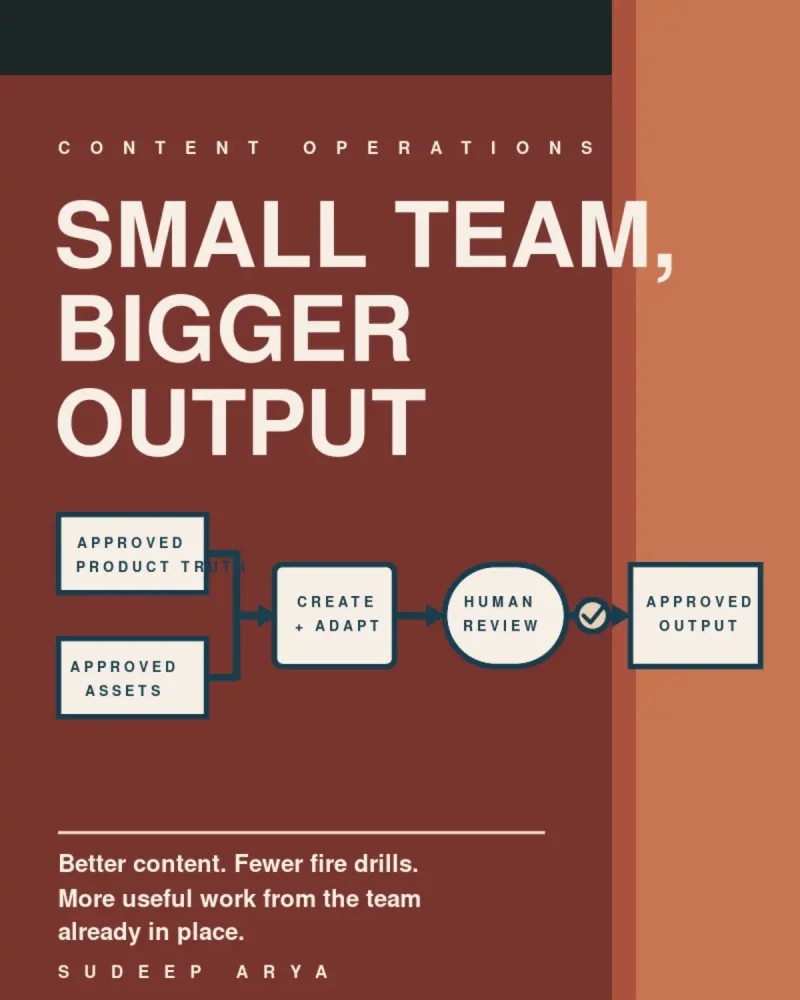
Four controls in this guide
The controlling thesis
More drafts are not the win.
Small teams win by turning approved product truth into approved channel content with fewer handoffs, less rework, and clear human decisions.
AI can prepare work faster. It cannot repair scattered facts, uncertain assets, missing ownership, or an approval queue nobody controls. Start with one repeated workflow. Make the source and decisions visible. Count what survives review.
Control the source
Reliable content begins with three governed inputs: product truth for facts and claims, brand truth for language and design rules, and asset truth for current versions, rights, and intended use.
The minimum useful control is not a platform. It is one approved record, one named owner, one visible status, and one route for conflicts. Objective claims require a reasonable basis, and human authorship remains central in current U.S. copyright guidance.12
Truth system
Make the approved input easier to use than the improvised one.
Product truth: facts, claims, qualifiers, channel variations, source evidence, and owner.
When product or asset platforms may become relevant
Official PIM and DAM documentation describes category capabilities for governing product information and assets.56 Evaluate those capabilities only after approved truth or asset control is established and repeated complexity still exceeds a maintained shared system.
Control the flow
Map one real product launch, PDP refresh, retailer syndication cycle, campaign, or localization update—not an imagined enterprise future. Record the owner, input, output, decision, elapsed time, correction loop, and exception route.
Separate necessary creation from planned review, correction, waiting, and exception resolution. A faster first draft creates no operating gain if review and correction expand.
Workflow + approval path
Follow the work to the next accountable decision.
Intake: define the deliverable, intended channel, owner, approval definition, and required source material.
Build, buy, or keep it simple
Ownership and a maintained shared system solve the repeated problem.
Documented volume, versions, rights, channels, or governance repeatedly exceed simple control.
A truly distinctive requirement has an accountable post-launch maintenance owner.
Validate the operating problem and lifecycle owner before selecting technology.
Decision
Do not automate a step until its input, owner, decision, evidence, and exception route can be described.
Control AI’s role
A useful AI workflow can retrieve approved inputs, identify missing information, draft controlled variations, compare against rules, prepare evidence, and route work. It should stop when a required source is missing, a claim lacks support, or an exception requires authority.
NIST emphasizes context, evaluation, monitoring, and governance across the AI lifecycle. Current technical documentation also demonstrates explicit human-approval patterns for AI tool calls.37
Human decision boundary
Preparation can be assisted. Authorization remains accountable.
- Retrieve approved sources
- Draft and reformat
- Compare, tag, route, and flag
- Prepare evidence
- Product truth and claims
- Brand and creative judgment
- Exceptions and customer context
- Final channel authorization
Escalate: missing data, conflicting sources, unsupported claims, changed channel, unusual risk, or unclear reviewer authority.
Control the outcome
Count content that completed required review and is authorized for its intended channel and use. Raw drafts, generated variants, and partially reviewed work are activity—not approved output.
Read approved output, approval loss, review/correction work, and optional labor cost per approved output together. Use a local baseline rather than an external productivity promise; findings vary by task, worker experience, technology, and setting.4
Approved-output scorecard + pilot sequence
One denominator keeps the next decision honest.
Compare equivalent work: keep approval definitions, deliverable scope, quality requirements, intended use, and measurement period consistent.
Definitions, limitations + references
Technical detail belongs behind the decision.
Definitions and formula boundary
An attempted deliverable enters creation whether it is approved, corrected, abandoned, failed, or unresolved. Approved output completed required review and is authorized for its intended use. Review/correction share divides modeled review and correction hours by total modeled creation plus review/correction hours. Cost per approved output appears only when labor cost is entered and approved output is above zero.
Research and evidence boundary
Government standards, regulatory guidance, academic research, official product documentation, and web standards support external claims. Vendor pages verify current category capability only; vendor ROI language is excluded. The frameworks and interface thresholds are original decision aids, not industry benchmarks.
Authorship, AI use + limitations
Artificial intelligence supported research organization, editing, visualization, production, and quality checks. The position, judgments, frameworks, practical operating perspective, and authorization remain Sudeep Arya’s. This publication does not claim client savings, typical ROI, production adoption, industry validation, audience performance, or audited financial outcomes.
References
- Federal Trade Commission, Policy Statement Regarding Advertising Substantiation.
- U.S. Copyright Office, Copyright and Artificial Intelligence, Part 2.
- NIST, AI Risk Management Framework 1.0, and Generative AI Profile.
- NBER, Generative AI at Work, and Large Language Models, Small Labor Market Effects.
- Official PIM documentation: Pimcore, Akeneo, and Salsify.
- Official DAM documentation: Bynder and Cloudinary.
- n8n, Human-in-the-loop for AI tool calls.
- W3C, Web Content Accessibility Guidelines 2.2.